Table of contents
Description
Question Link: LeetCode 148
Given the head of a linked list, return the list after sorting it in ascending order.
Example 1:
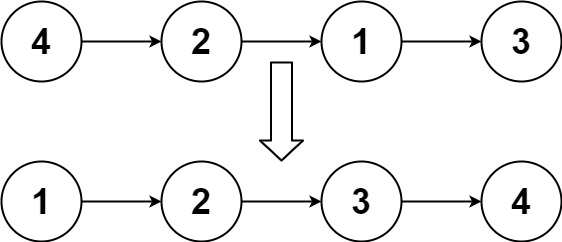
Input: head = [4,2,1,3]
Output: [1,2,3,4]
Example 2:

Input: head = [-1,5,3,4,0]
Output: [-1,0,3,4,5]
Example 3:
Input: head = []
Output: []
Constraints:
- The number of nodes in the list is in the range
[0, 5 * 10^4]. -10^5 <= Node.val <= 10^5
Follow up: Can you sort the linked list in O(n log n) time and O(1) memory (i.e. constant space)?
Idea1
Bottom-up iterative merge sort. Start with sublists of size 1, merge adjacent pairs, double the size, and repeat until the entire list is sorted. This avoids recursion entirely, achieving O(1) space.
Original:     4 → 2 → 1 → 3

Pass 1 (size=1): merge pairs of 1
  [4],[2] → 2,4    [1],[3] → 1,3
  Result:   2 → 4 → 1 → 3

Pass 2 (size=2): merge pairs of 2
  [2,4],[1,3] → 1,2,3,4
  Result:   1 → 2 → 3 → 4
Key operations: split(head, step) cuts after step nodes and returns the remainder; merge(left, right, prev) merges two sorted sublists and appends them after prev, returning the tail.
Complexity: Time — passes each doing work, Space .
Java
public class SortList {
    // O(nLgn) time, O(1) space. bottom up merge sort.
    public static ListNode sortList(ListNode head) {
        ListNode dummy = new ListNode(0);
        dummy.next = head;
        int n = 0;
        while (head != null) { head = head.next; n++; } // O(n) count length
        for (int step = 1; step < n; step <<= 1) { // O(log n) passes
            ListNode prev = dummy;
            ListNode cur = dummy.next;
            while (cur != null) { // O(n) per pass
                ListNode left = cur, right = split(left, step);
                cur = split(right, step);
                prev = merge(left, right, prev);
            }
        }
        return dummy.next;
    }

    private static ListNode split(ListNode head, int step) {
        if (head == null) return null;
        for (int i = 1; head.next != null && i < step; i++) head = head.next;
        ListNode right = head.next;
        head.next = null;
        return right;
    }

    private static ListNode merge(ListNode left, ListNode right, ListNode prev) {
        ListNode cur = prev;
        while (left != null && right != null) {
            if (left.val < right.val) { cur.next = left; left = left.next; }
            else { cur.next = right; right = right.next; }
            cur = cur.next;
        }
        if (left != null) cur.next = left;
        else if (right != null) cur.next = right;
        while (cur.next != null) cur = cur.next;
        return cur;
    }
}
Python
class Solution:
    """Bottom-up merge sort. O(n log n) time, O(1) space."""

    def sortList(self, head: Optional[ListNode]) -> Optional[ListNode]:
        if not head or not head.next:
            return head
        n = 0
        cur = head
        while cur:  # O(n) count length
            n += 1
            cur = cur.next
        dummy = ListNode(0)
        dummy.next = head
        step = 1
        while step < n:  # O(log n) passes
            prev, cur = dummy, dummy.next
            while cur:  # O(n) per pass
                left = cur
                right = self._split(left, step)
                cur = self._split(right, step)
                prev = self._merge(left, right, prev)
            step <<= 1
        return dummy.next

    def _split(self, head, step):
        if not head:
            return None
        for _ in range(step - 1):
            if not head.next:
                break
            head = head.next
        right = head.next
        head.next = None
        return right

    def _merge(self, left, right, prev):
        cur = prev
        while left and right:
            if left.val <= right.val:
                cur.next = left
                left = left.next
            else:
                cur.next = right
                right = right.next
            cur = cur.next
        cur.next = left if left else right
        while cur.next:
            cur = cur.next
        return cur
C++
class SolutionSortList {
public:
    // O(n log n) time, O(1) space. Bottom-up iterative merge sort.
    ListNode* sortList(ListNode* head) {
        if (!head || !head->next) return head;
        int len = 0;
        for (ListNode* p = head; p; p = p->next) ++len; // O(n)
        ListNode dummy(0);
        dummy.next = head;
        for (int size = 1; size < len; size <<= 1) { // O(log n) passes
            ListNode* prev = &dummy;
            ListNode* cur = dummy.next;
            while (cur) { // O(n) per pass
                ListNode* left = cur;
                ListNode* right = split(left, size);
                cur = split(right, size);
                prev = merge(left, right, prev);
            }
        }
        return dummy.next;
    }

private:
    ListNode* split(ListNode* head, int n) {
        for (int i = 1; head && i < n; ++i) head = head->next;
        if (!head) return nullptr;
        ListNode* rest = head->next;
        head->next = nullptr;
        return rest;
    }

    ListNode* merge(ListNode* l, ListNode* r, ListNode* prev) {
        while (l && r) {
            if (l->val <= r->val) { prev->next = l; l = l->next; }
            else { prev->next = r; r = r->next; }
            prev = prev->next;
        }
        prev->next = l ? l : r;
        while (prev->next) prev = prev->next;
        return prev;
    }
};
Rust
impl Solution {
    /// Bottom-up iterative merge sort. O(n log n) time, O(1) extra space.
    pub fn sort_list_bottom_up(head: Option<Box<ListNode>>) -> Option<Box<ListNode>> {
        let len = Self::length(&head);
        if len <= 1 { return head; }
        let mut head = head;
        let mut size = 1;
        while size < len {
            let mut dummy = Box::new(ListNode::new(0));
            let mut tail = &mut dummy;
            let mut cur = head;
            while cur.is_some() {
                let left = Self::cut(&mut cur, size);
                let right = Self::cut(&mut cur, size);
                tail.next = Self::merge(left, right);
                while tail.next.is_some() { tail = tail.next.as_mut().unwrap(); }
            }
            head = dummy.next;
            size *= 2;
        }
        head
    }

    fn cut(head: &mut Option<Box<ListNode>>, n: usize) -> Option<Box<ListNode>> {
        let mut cur = head.take();
        let mut tail = &mut cur;
        for _ in 0..n {
            if tail.is_none() { break; }
            tail = &mut tail.as_mut().unwrap().next;
        }
        *head = tail.take();
        cur
    }

    fn merge(mut l1: Option<Box<ListNode>>, mut l2: Option<Box<ListNode>>) -> Option<Box<ListNode>> {
        let mut dummy = Box::new(ListNode::new(0));
        let mut tail = &mut dummy;
        while l1.is_some() && l2.is_some() {
            let take_l1 = l1.as_ref().unwrap().val <= l2.as_ref().unwrap().val;
            if take_l1 {
                let mut node = l1.take().unwrap();
                l1 = node.next.take();
                tail.next = Some(node);
            } else {
                let mut node = l2.take().unwrap();
                l2 = node.next.take();
                tail.next = Some(node);
            }
            tail = tail.next.as_mut().unwrap();
        }
        tail.next = if l1.is_some() { l1 } else { l2 };
        dummy.next
    }

    fn length(head: &Option<Box<ListNode>>) -> usize {
        let mut count = 0;
        let mut cur = head;
        while let Some(node) = cur { count += 1; cur = &node.next; }
        count
    }
}
Idea2
Top-down recursive merge sort. Find the middle using slow/fast pointers, recursively sort each half, then merge the two sorted halves.
sortList([4,2,1,3])
├── sortList([4,2])
│   ├── sortList([4]) → [4]
│   ├── sortList([2]) → [2]
│   └── merge → [2,4]
├── sortList([1,3])
│   ├── sortList([1]) → [1]
│   ├── sortList([3]) → [3]
│   └── merge → [1,3]
└── merge [2,4] + [1,3] → [1,2,3,4]
Complexity: Time — recursion levels each merging nodes, Space for the recursion stack.
Java
public class SortList {
    // O(nLgn) time, O(Lgn) space. top-down merge sort.
    public static ListNode sortListRecursive(ListNode head) {
        if (head == null || head.next == null) return head;
        ListNode slow = head, fast = head.next;
        while (fast != null && fast.next != null) { // O(n/2) find middle
            slow = slow.next;
            fast = fast.next.next;
        }
        ListNode mid = slow.next;
        slow.next = null;
        ListNode left = sortListRecursive(head); // T(n/2)
        ListNode right = sortListRecursive(mid); // T(n/2)
        return mergeSorted(left, right);
    }

    private static ListNode mergeSorted(ListNode l1, ListNode l2) {
        ListNode dummy = new ListNode(0);
        ListNode cur = dummy;
        while (l1 != null && l2 != null) { // O(n)
            if (l1.val <= l2.val) { cur.next = l1; l1 = l1.next; }
            else { cur.next = l2; l2 = l2.next; }
            cur = cur.next;
        }
        cur.next = l1 != null ? l1 : l2;
        return dummy.next;
    }
}
Python
class Solution2:
    """Top-down merge sort (recursive). O(n log n) time, O(log n) space."""

    def sortList(self, head: Optional[ListNode]) -> Optional[ListNode]:
        if not head or not head.next:
            return head
        slow, fast = head, head.next
        while fast and fast.next:  # O(n/2) find middle
            slow = slow.next
            fast = fast.next.next
        mid = slow.next
        slow.next = None
        left = self.sortList(head)  # T(n/2)
        right = self.sortList(mid)  # T(n/2)
        return self._merge(left, right)

    def _merge(self, l1, l2):
        dummy = ListNode(0)
        cur = dummy
        while l1 and l2:  # O(n)
            if l1.val <= l2.val:
                cur.next = l1
                l1 = l1.next
            else:
                cur.next = l2
                l2 = l2.next
            cur = cur.next
        cur.next = l1 if l1 else l2
        return dummy.next
C++
class SolutionSortList {
public:
    // O(n log n) time, O(log n) stack space. Top-down recursive merge sort.
    ListNode* sortListRecursive(ListNode* head) {
        if (!head || !head->next) return head;
        ListNode* slow = head;
        ListNode* fast = head->next;
        while (fast && fast->next) { // O(n/2) find middle
            slow = slow->next;
            fast = fast->next->next;
        }
        ListNode* mid = slow->next;
        slow->next = nullptr;
        ListNode* left = sortListRecursive(head); // T(n/2)
        ListNode* right = sortListRecursive(mid); // T(n/2)
        return mergeTwoLists(left, right);
    }

private:
    ListNode* mergeTwoLists(ListNode* l, ListNode* r) {
        ListNode dummy(0);
        ListNode* tail = &dummy;
        while (l && r) { // O(n)
            if (l->val <= r->val) { tail->next = l; l = l->next; }
            else { tail->next = r; r = r->next; }
            tail = tail->next;
        }
        tail->next = l ? l : r;
        return dummy.next;
    }
};
Rust
impl Solution {
    /// Top-down recursive merge sort. O(n log n) time, O(log n) stack space.
    pub fn sort_list(head: Option<Box<ListNode>>) -> Option<Box<ListNode>> {
        if head.is_none() || head.as_ref().unwrap().next.is_none() {
            return head;
        }
        let (left, right) = Self::split(head);
        let left = Self::sort_list(left);
        let right = Self::sort_list(right);
        Self::merge(left, right)
    }

    fn split(head: Option<Box<ListNode>>) -> (Option<Box<ListNode>>, Option<Box<ListNode>>) {
        let len = Self::length(&head);
        let mid = len / 2;
        Self::cut_at(head, mid)
    }

    fn cut_at(head: Option<Box<ListNode>>, at: usize)
        -> (Option<Box<ListNode>>, Option<Box<ListNode>>)
    {
        let mut dummy = Box::new(ListNode::new(0));
        dummy.next = head;
        let mut cur = &mut dummy;
        for _ in 0..at { cur = cur.next.as_mut().unwrap(); }
        let right = cur.next.take();
        let left = dummy.next;
        (left, right)
    }
}